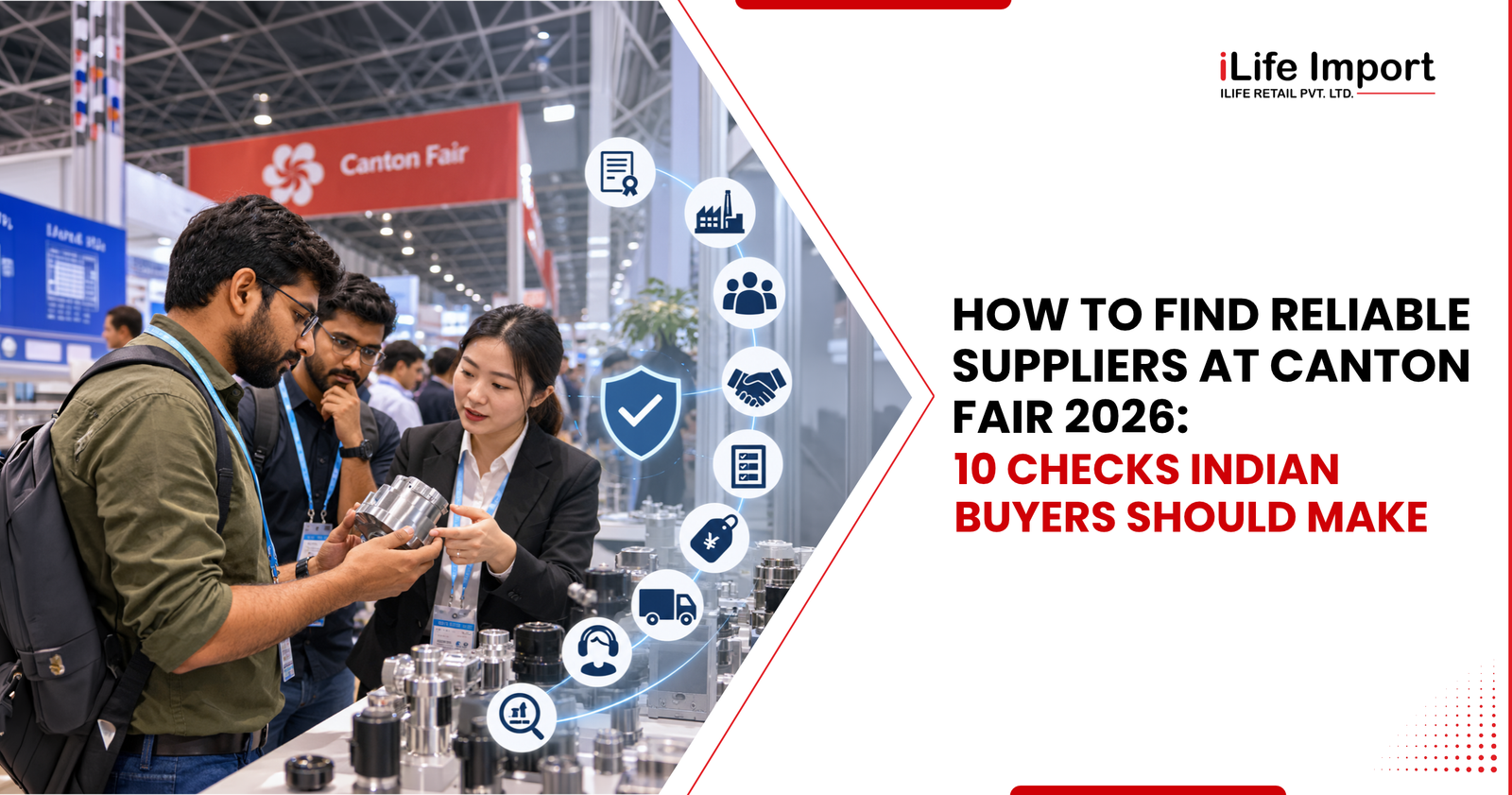
At Canton Fair 2026, Indian importers can search exhibitors and products through the official Canton Fair platform, which currently lists 13 categories and 54 exhibition sections. The challenge isn't finding suppliers-it's identifying which ones deserve serious consideration.
The right supplier can influence your product quality, margins, delivery schedule and long-term business. A low quotation is not proof of a reliable supplier.
So, how can an Indian buyer separate a capable manufacturer from a supplier who simply has a convincing sales pitch?
1. Look Beyond the Booth Appearance
A polished booth, professional catalogue or fluent salesperson can create a strong first impression—but these should be starting points, not confirmation
Record:
- Company name and booth number
- Factory location
- Contact person's details
- Main products
- Years in business
- Target export markets
- Manufacturer or trading-company status
Use the official Canton Fair exhibitor/product search to research suppliers before and after your visit. The platform also allows buyers to submit sourcing requests for supplier matching.
Tip: Don't judge reliability by booth size or presentation alone.
2. Check Manufacturing Capability
Ask specific questions about the factory:
- Where is the production facility?
- What products are manufactured there?
- What is the monthly production capacity?
- How many production lines are available?
- Which processes are handled in-house?
- Can they handle your expected order quantity?
If a supplier claims to be a manufacturer, ask for factory information and relevant evidence. For higher-value orders, an independent factory verification or audit can provide additional confidence.
A supplier who cannot clearly explain where and how your product is manufactured requires further review
3. Look for Export Experience
Ask whether the supplier already exports products similar to yours.
Useful questions include:
- Which countries do you currently export to?
- Have you supplied to other Indian customers?
- What product models are commonly exported and abide by Indian regulations ?
- Can you provide relevant export references or documentation?
Export experience doesn't automatically guarantee reliability, but experience with international buyers can help you assess whether the supplier understands documentation, packaging, product specifications and international quality expectations.
4. Verify Product Quality with Samples
Never select a supplier solely from photographs or catalogue specifications.
Request samples and check:
- Material and construction
- Dimensions
- Finish and appearance
- Functionality
- Packaging
- Labelling
- Accessories
- Performance against your specification
Ideally, request comparable samples from several suppliers.
If Supplier A offers a lower price but Supplier B consistently provides better samples against the same specification, the price difference deserves closer examination.
5. Compare Multiple Suppliers offering Similar Products
Don't stop at the first supplier who says “yes.”
Create a comparison sheet covering:
|
Factor
|
Supplier A
|
Supplier B
|
Supplier C
|
|
Manufacturer status
|
✓/✗
|
✓/✗
|
✓/✗
|
|
Sample quality
|
✓
|
✗
|
✓
|
|
MOQ
|
✓
|
✗
|
✓
|
|
Price
|
✓
|
✗
|
✓
|
|
Certifications
|
✓/✗
|
✓/✗
|
✓/✗
|
|
Production time
|
✓
|
✗
|
✓
|
|
Customisation
|
✓/✗
|
✓/✗
|
✓/✗
|
|
Export experience
|
✓/✗
|
✓/✗
|
✓/✗
|
This turns a busy Canton Fair visit into an evidence-based shortlist.
6. Check MOQ, Pricing and Trade Terms
A quotation is useful only when you understand what it includes.
A check list that can help you in deciding terms:
- Unit price
- MOQ
- Sample charges
- Tooling or mould charges
- Packaging costs
- Customisation costs
- Price validity
- Payment schedule
For example, a supplier offering a lower unit price but requiring a very large MOQ may not be suitable for a first time or small to mid-sized Indian importer.
Compare the complete commercial offer-not just the unit price.
7. Verify Certifications and Compliance
Ask for certificates relevant to the exact product, model and manufacturing facility.
For Indian buyers, this is particularly important where products fall under mandatory Indian standards or Quality Control Orders. BIS certification is generally voluntary,, but certain products require mandatory compliance and a BIS Standard Mark/licence or applicable conformity requirements.
Check:
- Certificate number
- Product/model covered
- Manufacturer name
- Factory address
- Validity
- Applicable standard
- Test reports
Do not assume that a certificate supplied by a salesperson automatically covers the product you intend to import.
Check BIS products under compulsory certification
8. Start with a Small Order
For a new supplier, consider starting with a smaller commercial order where practical.
This gives you an opportunity to evaluate:
- Actual product quality
- Packaging
- Communication
- Production consistency
- Delivery performance
- Documentation
- Response to problems
A successful sample or showroom visit is not the same as proven mass-production performance.
9. Verify the Supplier before Commercial Commitment
Before making a substantial payment, verify the supplier's:
Company → Factory → Product → Certifications → Quotation → Contract terms
For higher-value purchases, consider third-party supplier verification, factory inspection and pre-shipment inspection.
BIS itself uses manufacturing infrastructure, process controls, quality control and testing capability as part of its certification framework, illustrating why factory capability should be evaluated alongside paperwork.
Common Supplier Red Flags
Be cautious when you encounter:
- Unusually low pricing compared with comparable suppliers
- Reluctance to disclose factory information
- Certificates that don't match the manufacturer or product
- Constantly changing bank-account details
- Pressure to make immediate payment
- Inconsistent product specifications
- Vague answers about production capacity
- Refusal to provide samples
- Poor communication after quotation
One red flag may not prove a supplier is unsuitable, but multiple unresolved issues should trigger additional verification.
10. Plan What Happens after the Fair
Finding a promising supplier is only the beginning.
After the Canton Fair, organise your visiting cards, quotations and samples, verify shortlisted suppliers, confirm specifications, negotiate final terms and arrange inspection where appropriate.
Then move to What to Do After Finding a Supplier at Canton Fair 2026 → How to Calculate Landed Cost → Import Services.
For Indian businesses that need help coordinating supplier verification, purchase management and support or quality inspection in China, iLife Import can support the practical steps between supplier identification and shipment planning without making supplier discovery the entire sourcing strategy.
Finding a Supplier is NOT the same as Finding a Reliable Supplier
Canton Fair 2026 gives Indian buyers access to a large supplier ecosystem, but the responsibility for evaluating suitability remains with the buyer.
Look beyond the booth. Check the factory. Test the product. Verify compliance. Compare suppliers. Review commercial terms. Start cautiously and verify before making a significant commitment.
The goal isn't to find the supplier with the best sales pitch—it is to build enough evidence to make a well-informed sourcing decision.
FAQs
Is Canton Fair suitable for first-time importers?
Yes. First-time importers can use the fair to checkout new and innovative products, to meet multiple suppliers and compare products, samples, MOQs and commercial terms. However, they should conduct proper supplier verification before placing a significant order.
How do I know whether a supplier is a manufacturer?
Ask for the factory address, manufacturing capabilities, production-line information and evidence of the facility. For important orders, consider an independent factory verification or physical inspection.
How many suppliers should I compare before selecting one?
There is no universal number. Compare several suppliers offering the same or closely comparable specification, then shortlist those that meet your requirements for quality, capability, compliance, MOQ, pricing and terms.
What are the biggest red flags when selecting a Chinese supplier?
Unusually low prices, inconsistent company information, unverifiable certificates, reluctance to disclose manufacturing details, unclear specifications and pressure for immediate payment are reasons to conduct additional checks.
Should I order samples before choosing a Canton Fair supplier?
Yes, wherever practical. Samples allow you to compare actual product quality against your specification and between shortlisted suppliers before committing to larger quantities.
What should I do after shortlisting a Canton Fair supplier?
Verify the supplier and factory, confirm product specifications and certifications, finalise commercial terms, assess inspection requirements and calculate your expected landed cost before making a significant commercial commitment.