Introduction:
Finding a promising supplier at Canton Fair is exciting. Trusting the supplier and placing an order is another matter.
The real sourcing work begins after you exchange contact details, collect a quotation and return from the exhibition. Indian importers need to verify the supplier, test the product, confirm specifications, negotiate commercial terms and establish quality controls before committing money.
A good supplier meeting is only a start-not proof that the supplier is ready for your order.
So, what should you do between “I found a supplier” and “I am ready to place the purchase order”?
1. Organise Supplier Meetings, Quotations and Samples
Start by creating a supplier comparison sheet while the information is still fresh.
Record:
- Company and factory name
- Contact person and details
- Product/model numbers
- Quoted price and currency
- Minimum Order Quantity
- Sample availability
- Production lead time
- Payment terms
- International Commercial Terms (Incoterms)
- Customisation options
- Certifications and test reports
Separate suppliers offering the same specification so you are comparing like-for-like quotations.
If you collected samples, label each one with the supplier name and model number. This simple step can prevent confusion when several suppliers offer similar products.
2. Verify the Supplier Before Negotiating Seriously
Before discussing a large purchase, confirm who you are actually dealing with.
Ask for:
- Legal company name
- Business registration information
- Factory address
- Manufacturing capabilities
- Export markets served
- Relevant product certifications
- Payment terms
If the supplier claims to be a manufacturer, ask where the product is made and what processes are performed in-house.
For a high-value order, independent factory verification or an audit can provide additional evidence before commercial commitment.
3. Request and Evaluate Samples
A catalogue tells you what the supplier claims to sell. A sample lets you examine what they can actually produce.
Compare samples against your requirements for:
- Material
- Dimensions
- Finish
- Functionality
- Colour
- Packaging
- Labelling
- Accessories
- Performance
If you require customisation, request a sample or approved pre-production sample before mass manufacturing.
Do not approve production based only on product photographs.
4. Confirm Product Specifications in Writing
This is where many supplier discussions become risky: the buyer and supplier may have different interpretations of the same product.
Create a written specification covering the exact model, dimensions, materials, tolerances, packaging, branding, testing requirements and quantity.
For customised products, attach approved drawings, artwork or technical specifications to the purchase documentation.
The objective is simple: the product ordered should be clearly identifiable on paper before production starts.
5. Negotiate, Price and Commercial Terms
Once the supplier has passed your initial checks, negotiate the complete commercial package—not just the unit price.
Discuss:
- Unit price
- Sample/tooling charges
- Packaging
- Branding
- Payment schedule
- Incoterm
- Production lead time
- Replacement policy for defective goods
- Price validity
A supplier offering the lowest unit price may not offer the lowest overall cost if its MOQ, quality, packaging or other terms are less suitable.
This is also the right stage to calculate your expected landed cost in India, rather than judging profitability from the supplier quotation alone.
Check the landed cost of your order by contacting us at iLife Import
6. Check Certifications and Indian Compliance Requirements
Before finalising the product, determine whether Indian regulations apply to it.
BIS states that certification is generally voluntary, but certain products are brought under mandatory compliance through government notifications and Quality Control Orders. Such products may require applicable BIS certification, Standard Mark or conformity requirements before import or sale.
Therefore, verify that certificates and test reports:
- Match the exact product
- Identify the relevant manufacturer
- Cover the applicable model/specification
- Verify the expiry and verity of the same
- Fulfill the Indian requirement applicable to your product
Don't accept a certificate merely because its logo appears on a supplier's document.
7. Arrange Inspection Before the Shipment
For a new supplier or significant order, consider independent inspection before shipment.
Depending on the product, inspection may cover:
- Quantity
- Dimensions
- Appearance
- Functionality
- Packaging
- Labelling
- Defects
- Product specifications
Supplier verification does not replace inspection, but it creates another quality-control checkpoint between production and shipment.
8. Finalise the Purchase Order
Once the supplier passes your checks, put the agreement into a formal purchase order or contract.
Clearly specify:
Product → Specification → Quantity → Price → Packaging → Quality requirements → Delivery date → Payment terms → Inspection requirements
Make sure the supplier's legal entity and payment beneficiary are consistent with the verified information.
Avoid making significant payments based only on WhatsApp conversations or an informal quotation.
9. Prepare for Shipment and India Delivery
After the purchase order is confirmed, coordinate production, inspection and shipment according to the agreed terms.
For Indian imports, ICEGATE states that commonly required import documents include the Bill of Lading/Airway Bill, Commercial Invoice, Packing List and Bill of Entry, with additional documents depending on the commodity and applicable government-agency requirements.
You don't need to solve the entire logistics process immediately after the fair. The priority is ensuring that the supplier, product, documentation and order terms are correctly aligned before shipment.
The Post-Canton Fair Process at a Glance
Use this sequence:
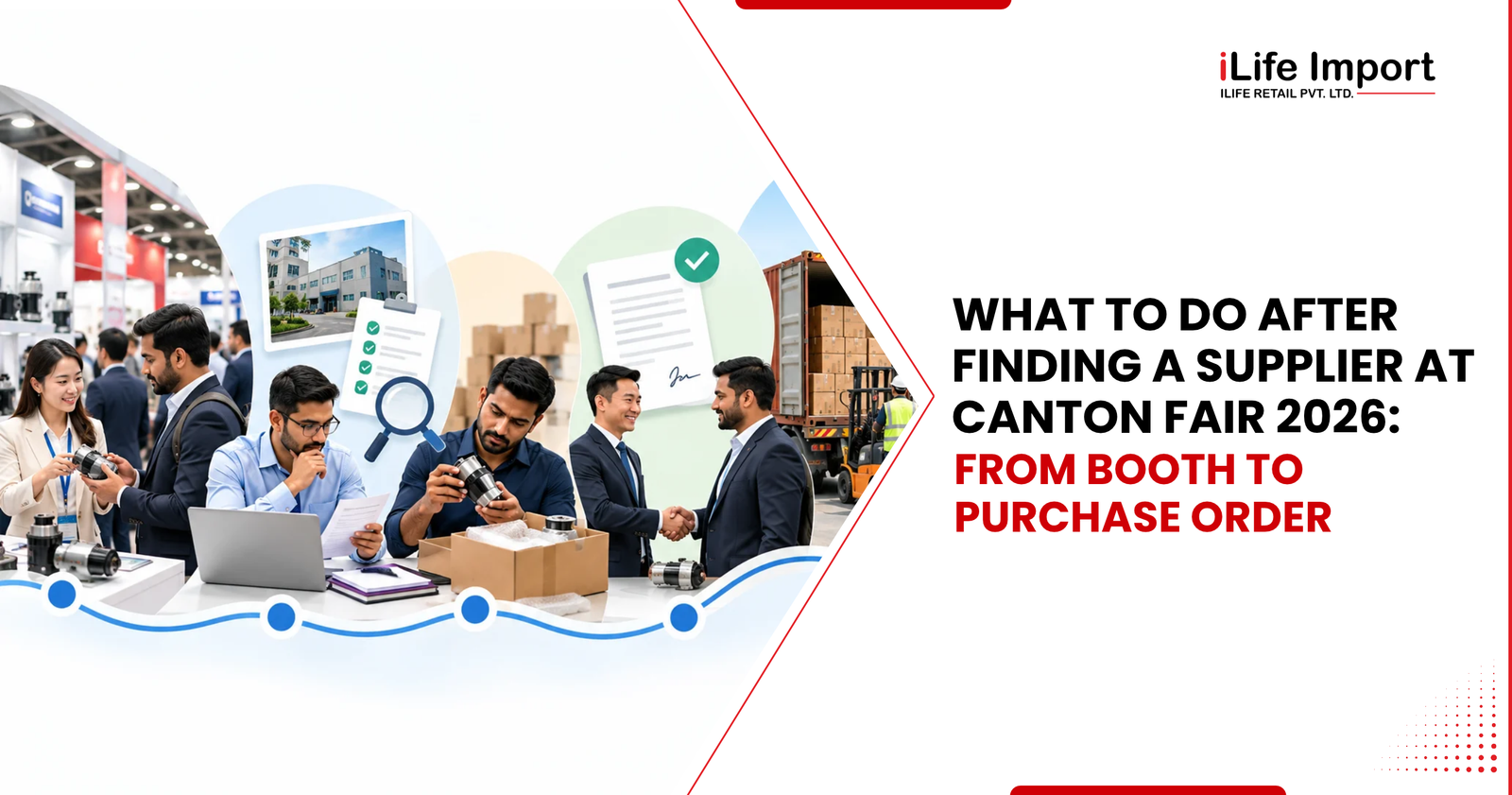
Supplier Meeting → Quotation → Sample → Verification → Negotiation → Inspection → Purchase Order → Shipment → Customs → Delivery
This creates a clear bridge between finding a supplier and successfully completing the purchase.
For Indian buyers who need support coordinating supplier verification, buying, quality inspection and the China-to-India import process, iLife Import can help manage relevant steps after supplier discovery.
What Indian Buyers Should Do Next
Don't treat Canton Fair as the finish line. Treat it as the point where supplier evaluation becomes more detailed.
Verify the company. Test the sample. Confirm specifications. Negotiate the complete commercial terms. Check applicable compliance requirements. Arrange inspection where appropriate. Then issue the purchase order and prepare for shipment.
For the next stage, connect this process with [Canton Fair 2026: Dates, Phases & Indian Importer Guide] → [Phase 1] → [Phase 2] → [Phase 3] → [How to Calculate Landed Cost] → [Import Services].
The supplier has been found—but have you completed every verification step before placing the order?
FAQs
1. What should I do immediately after finding a supplier at Canton Fair?
Organise the supplier's quotation and contact information, request samples, confirm product specifications and verify the company's identity and manufacturing capability before making a significant commercial commitment.
2. Should I negotiate before verifying the supplier?
You can discuss indicative pricing and MOQ at the fair, but detailed commercial commitment should follow supplier, product and compliance verification.
3. Should I inspect products before shipment?
For new suppliers or significant orders, pre-shipment inspection can provide an additional quality-control checkpoint before goods leave China. The scope should match the product and order risk.
4. What documents should I confirm before placing an order?
At minimum, ensure you have a clear quotation/proforma invoice, product specifications, agreed commercial terms and relevant compliance documents. For importing into India, additional documents may depend on the product and applicable regulations.
5. How do I calculate whether a Canton Fair order is profitable?
Don't compare your selling price only with the supplier's unit price. Calculate the expected landed cost, including relevant China-side charges, freight, applicable duties/taxes, clearance and delivery costs